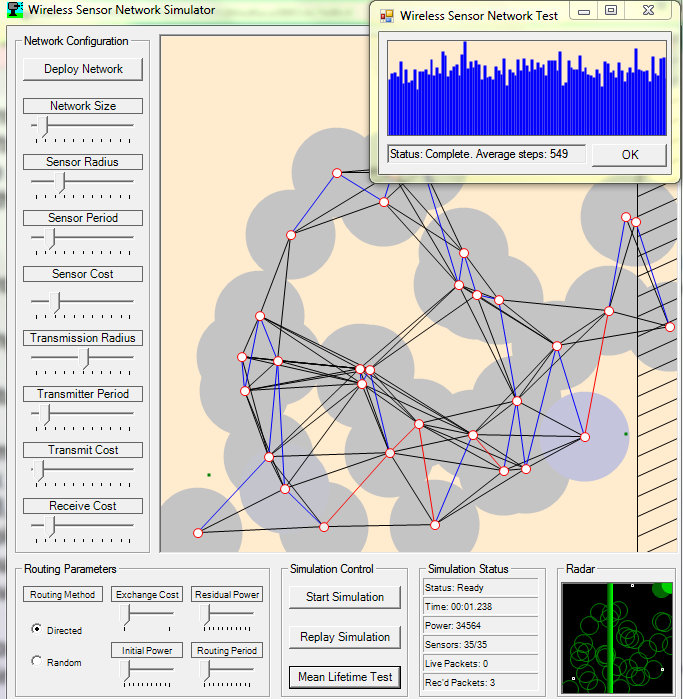
Wireless Sensor Network Simulator v1.1 showing the simulation on deployed sensor network and in inset Sensor Network Node’s Mean lifetime test, by David J. Stein
This article gives insight review to explore features and possibilities of a Wireless Sensor Network Simulator v1.1 which is programmed by David J. Stein.
OMNeT++ – The Open Simulator, official page at http://omnetpp.org
OMNeT++ is a discrete event based network
simulation framework which provides modularity in open architecture for simulation of computer and related communication networks. OMNeT++ Modeling and Simulation is being used by many researchers and academicians in recent years.
The application and importance of sensor network depends on the type of sensor nodes used, the field & scope of deployment, the computational and QoS requirements. Event detection, location sensing, control of actions to be taken under certain criteria are frequent requirements in sensor networks. Sensors vary from seismic, low sampling rate magnetic, thermal, visual, infrared, acoustic and radar, which are able to monitor a wide variety of ambient conditions ...
Sensor network differ from the traditional ISO OSI Model of Communication Standards. Sensor nodes are not necessarily IP equipped and the seven layers of OSI model are in harmony with just three protocol stacks, namely, power management plane, mobility management plane and task management plane. This protocol stack performs functions of sensor network and combines power and routing awareness, integrates data with networking protocols, communicates power efficiently through the wireless ...
The design of SN is a challenge because many influencing factors such as fault tolerance, scalability, production cost, operating environment, network topology, hardware constraints, transmission media, power consumption and others have to be considered. The performance of the network is then measured based on quantifiable parameters called performance metrics. This however varies according to need and the nature of SN.
Networked sensors simply form a network of interconnected entities of vested interests. Sensors help realize the Internet of Things and Inclusion. Sensor networks when equipped with internet connection help build networks based on the interests and parameters required. The social networks can be built based on the similarities of attributes to be sensed, data to be processed, and functions to be computed.
The virtual presence of everyday domestic entities, unexplorable geographic ...
SN can form the base of cloud computing, distributed computing, and Next Generation Networks (NGN). For this, sink nodes can be used as a gateway to interconnect other networks, and backbone scenarios for more connected networks. Router equipped with sensing capabilities can work for saving powers and sleep when there is no activity in the network or so.
Transport layer is specially needed when the system is planned to be accessed ...
OFDMA Networks: The subcarriers and powers can be allocated according to user’s requirement. BS dynamically controls the resource allocation in two categories – Rate Adaptation (RA) which maximized thru put and Margin Adaptation (MA) which minimizes the total transmitted power. The frequency diversity is yet to be exploited with the consideration of circuitry consumption for frequency-selective fading channels which aids in reduction in energy consumption.
I thought I know this subject matter but.. alas! the world is a different scenario now. All areas are of human interest, none of them are left untouched. For an instance, I thought I knew the difference between
hardware and software, I thought I knew the logic behind the Ohm’s law formula, I thought I knew the difference between Wireless Sensor Networks (WSN) and Ad-hoc ...